
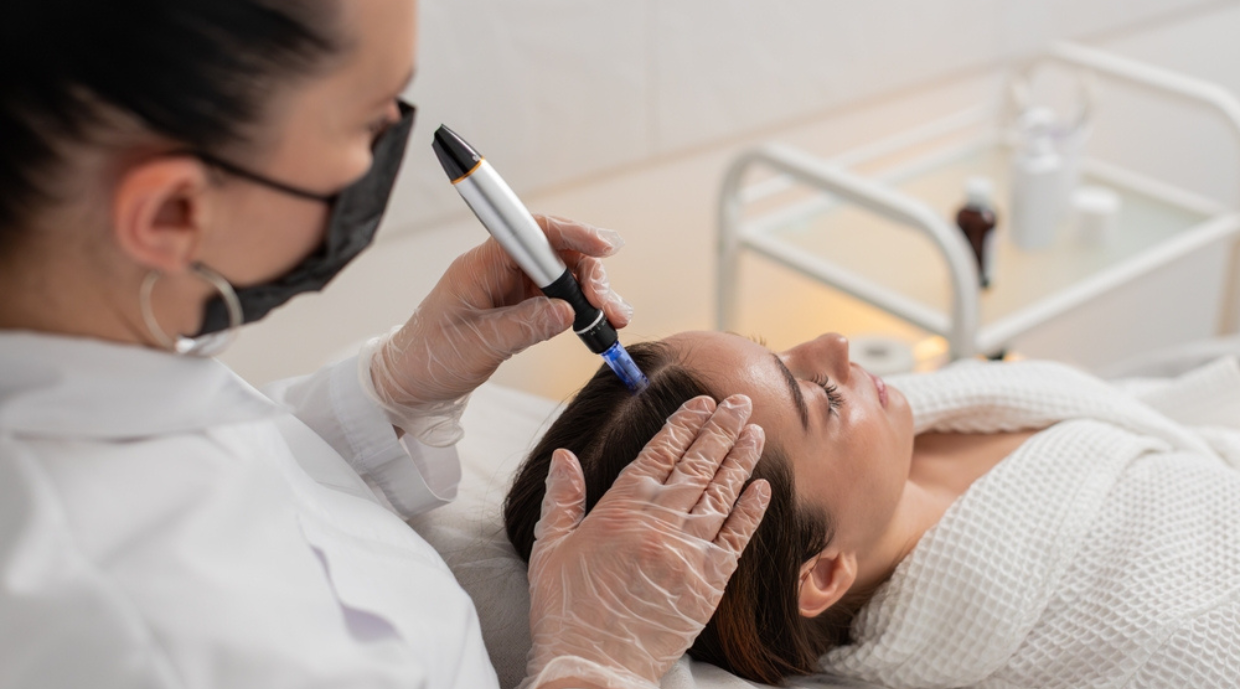
Hair thinning often leads people to look for treatments that may improve density or reduce ongoing shedding. With GFC, however, visible changes are generally gradual because hair follicles follow their natural growth cycle.
If you are considering GFC hair treatment in Bangalore, it is useful to understand what may happen during the first few weeks, the following months, and longer-term follow-up. There is no fixed day when everyone starts seeing results. The timeline depends on the cause and stage of hair loss, follicle activity, scalp health, treatment schedule, and individual response.
What Does GFC Hair Treatment Aim to Do?
GFC stands for Growth Factor Concentrate. The treatment involves collecting a small amount of the patient’s own blood and processing it to obtain a concentrate containing growth factors. This preparation is then introduced into selected areas of the scalp.
The treatment is generally considered when existing hair follicles are still present. Its purpose is to support those follicles rather than create completely new follicles in areas where permanent follicular loss has already occurred.
This distinction is important when setting realistic expectations.
Hair thinning can also occur for many reasons. Hereditary pattern hair loss, hormonal changes, nutritional deficiencies, significant stress, scalp conditions, certain medications, and medical problems may all contribute.
Understanding the causes of hair loss and available treatments helps explain why two people receiving similar GFC treatment may experience different outcomes.
When Might GFC Hair Treatment Results Become Noticeable?
Visible changes are usually gradual.
Hair does not suddenly become denser immediately after a GFC session. Existing follicles need time to progress through different stages of the natural hair-growth cycle before changes become noticeable.
During the early weeks, some people may notice a change in shedding before they see any visible difference in density. Others may not notice much initially.
A lack of immediate visible change does not automatically mean the treatment has failed.
Clinical research into concentrated growth-factor treatments for androgenetic alopecia has generally assessed outcomes over several months rather than a few days. A 2024 study, for example, evaluated patients at three and six months after treatment, reinforcing the importance of allowing sufficient time before judging results.
What Changes May Appear First?
The first sign of improvement is not always obvious new hair growth.
Some patients may initially notice:
- Less noticeable shedding
- Changes in hair quality
- Improved appearance of existing strands
- Gradual improvement in thickness
- Reduced scalp visibility over time
Visible density can take longer to assess because newly growing or strengthening hair needs time to reach a noticeable length.
Small changes may also be difficult to detect without consistent photographs. Looking at the scalp every day may make progress particularly difficult to recognize.
Published research has reported improvements in measures such as hair density and hair count following concentrated growth-factor treatments. However, studies use different preparation methods and treatment schedules, so results should not be treated as identical for every patient.
Patients considering GFC and PRP treatment should therefore focus on their own clinical assessment and progress rather than comparing their timeline directly with another person’s experience.
Why Do GFC Results Vary Between People?
Several factors influence how quickly and how noticeably someone may respond.
Stage of Hair Loss
The stage of thinning matters.
Someone with early or moderate follicular miniaturization may have different treatment potential from someone with long-standing or advanced hair loss.
GFC works with follicles that are still present. Areas where follicular activity has been extensively lost may respond differently from areas where hairs are simply becoming thinner.
Cause of Hair Loss
Hair loss is a symptom rather than one single condition.
If shedding is related to nutritional deficiencies, thyroid problems, hormonal changes, scalp inflammation, illness, medications, or another medical factor, addressing the underlying cause may be necessary alongside or instead of GFC.
This is why diagnosis should come before selecting a treatment schedule.
Scalp and Follicle Health
The condition of the scalp may also influence treatment planning.
Significant dandruff, inflammation, active infection, or another scalp disorder may need attention. Existing follicles may also differ in how advanced their miniaturization has become.
Treatment Schedule
GFC protocols are not completely standardized.
Some treatment plans may involve an initial series of sessions spaced several weeks apart, followed by reassessment. The appropriate schedule depends on the patient’s diagnosis, stage of thinning, and response.
Reviewing the broader range of hair loss treatment options can help place GFC within a complete management plan rather than treating it as the only available option.
How Should GFC Progress Be Assessed?
Daily mirror checks are not the most reliable way to judge hair-treatment results.
Hair may look noticeably different depending on:
- Lighting
- Hair length
- Styling
- Scalp oiliness
- Hair washing
- How the hair is parted
- Camera angle
Standardized photographs taken under similar conditions can provide a better comparison.
During follow-up, the clinician may also review shedding, scalp condition, hair density, and changes in hair-shaft quality. In some cases, magnified scalp assessment may provide additional information about follicles and hair thickness.
Progress should be compared with the patient’s own starting point rather than another person’s photographs.
What If You Do Not See Results Quickly?
Slow improvement does not necessarily mean additional sessions should immediately be added.
Hair growth takes time. It may be more appropriate to complete the recommended treatment course and allow enough time for the scalp and follicles to respond before judging the outcome.
If there is little meaningful improvement after an appropriate review period, the cause of hair loss may need to be reassessed.
Further evaluation may be particularly important when hair loss:
- Continues to progress rapidly
- Appears suddenly
- Occurs in patches
- Is accompanied by itching or inflammation
- Develops alongside other health symptoms
Another treatment strategy may be more suitable depending on the findings.
For selected patients, PRP treatment for hair loss may also be considered within the wider range of non-surgical hair-loss options.
The decision should be based on diagnosis and suitability rather than simply changing treatments because visible results have not appeared quickly.
Does More GFC Mean Faster Results?
Not necessarily.
Hair follicles follow biological growth cycles, so increasing the frequency or number of sessions does not automatically make hair grow faster.
Treatment schedules should allow enough time between sessions for the scalp to recover and for progress to be evaluated.
More treatment is not always better treatment.
If improvement is slower than expected, reviewing the diagnosis, follicular condition, underlying health factors, and overall treatment plan is more useful than automatically adding sessions.
How Long May GFC Results Last?
The duration of any improvement varies between individuals.
Pattern hair loss is generally progressive, meaning the underlying tendency toward thinning may continue over time. GFC does not necessarily remove this underlying tendency.
Some patients may therefore be advised to return for periodic reassessment or maintenance treatment.
Others may require additional medical, scalp, or lifestyle management depending on the cause of their hair loss.
Maintenance should be based on individual response rather than scheduled automatically for every patient.
What Are Realistic Expectations From GFC?
Realistic expectations are an important part of treatment planning.
GFC should not be presented as a guaranteed way to:
- Restore every lost hair
- Reverse advanced baldness
- Produce immediate regrowth
- Permanently stop every type of hair loss
- Deliver identical results for everyone
For suitable patients, the goal may instead be to support existing follicles, improve hair-related parameters, or help manage progressive thinning as part of a wider treatment plan.
A proper assessment helps determine whether these goals are realistic for the individual’s hair-loss pattern.
Conclusion
GFC hair treatment results are generally gradual rather than immediate. Some people may first notice changes in shedding or hair quality, while visible differences in thickness or density may require several months to assess properly.
The timeline varies according to the cause and stage of hair loss, follicle activity, scalp condition, treatment schedule, and individual response.
If you are considering GFC hair treatment in Bangalore, begin with a proper hair and scalp assessment. It helps determine whether GFC is appropriate, establish realistic expectations, and track progress based on your own hair-loss pattern.
Frequently Asked Questions
1. Can GFC hair treatment show results after one session?
Some people may notice early changes after the first session, but one treatment is generally too early to judge the overall result. Progress usually needs to be evaluated over a longer period.
2. How long does it take to see visible hair growth after GFC?
There is no fixed timeline. Hair grows gradually, so noticeable changes may take several months depending on the stage and cause of hair loss.
3. Does reduced hair fall mean GFC is working?
Reduced shedding may be an encouraging change, but it should not be the only measure. Hair density, scalp condition, photographs, and overall progression should also be reviewed.
4. Why are my GFC results different from another person’s?
Hair-loss cause, follicle condition, severity, treatment schedule, scalp health, and individual biological response vary considerably between people.
5. Do GFC hair treatment results last permanently?
Not necessarily. Some forms of hair loss are progressive, so follow-up, maintenance, or additional management may be recommended depending on how the hair responds.


