
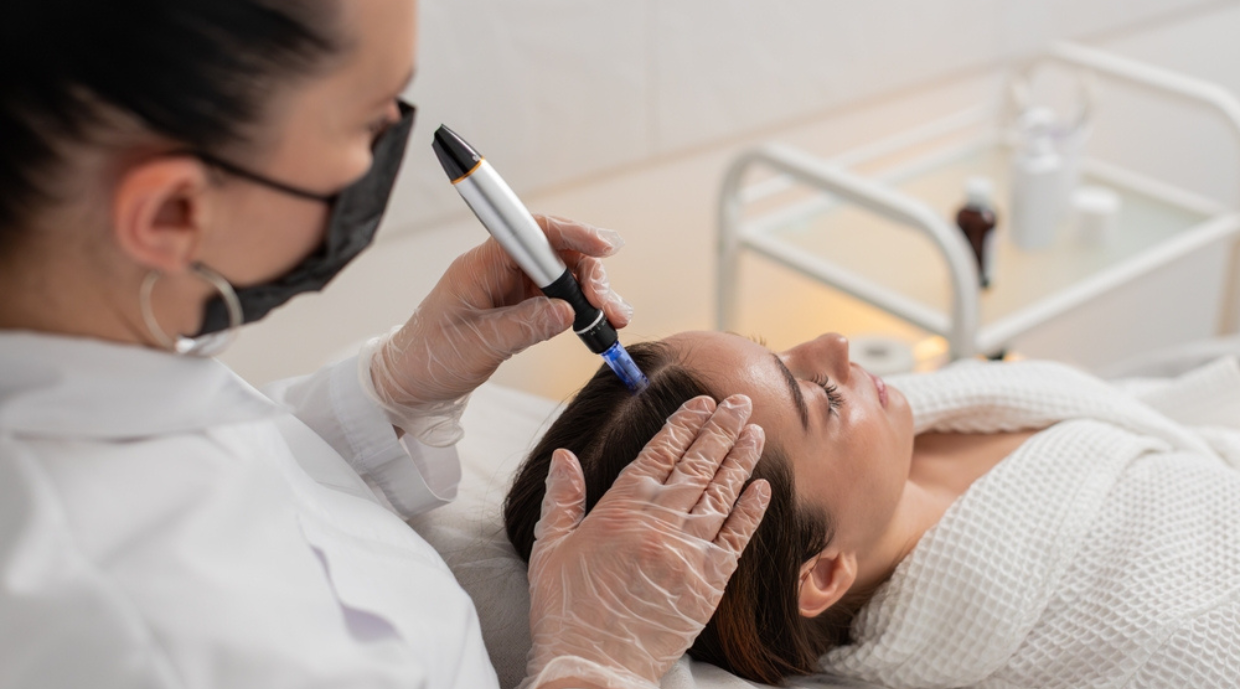
Early hair thinning may begin with small changes rather than obvious baldness. Your parting may look slightly wider, more scalp may become visible under bright light, or your hair may feel less dense than it did several months ago.
If you are considering PRP treatment in Bangalore, identifying these changes early can be useful. However, noticing more hair fall does not automatically mean PRP is the right treatment. The cause of thinning, condition of existing follicles, scalp health, progression of hair loss, and medical history all need to be considered first.
What Is Considered Early Hair Thinning?
Early hair thinning generally refers to a gradual reduction in hair density or strand thickness before extensive areas of hair loss develop.
In pattern hair loss, individual follicles may slowly become smaller and begin producing thinner and shorter hairs. This process is often called follicular miniaturization.
Men may first notice recession around the temples, lower density at the crown, or gradual changes along the frontal hairline. Women may notice widening of the central parting, reduced volume, or increased scalp visibility.
However, thinning is not always caused by hereditary pattern hair loss.
Stress, illness, nutritional deficiencies, hormonal changes, medications, scalp conditions, and other health factors may also contribute to shedding. Understanding the possible causes of hair loss should therefore come before choosing PRP or another procedure.
How Does PRP Hair Treatment Work?
PRP stands for platelet-rich plasma.
The treatment begins with a small sample of the patient’s own blood. The blood is processed so that the platelet-rich portion of the plasma can be separated and prepared for use on selected areas of the scalp.
PRP works with existing follicles. It should not be viewed as a treatment that creates completely new follicles where permanent follicular loss has already occurred.
This distinction matters particularly during early hair thinning. A follicle that is becoming progressively smaller is different from an area where follicular activity has already been lost.
People exploring PRP hair treatment should therefore have the pattern and cause of thinning evaluated before deciding whether the procedure is appropriate.
When May PRP Be Considered for Early Hair Thinning?
PRP may be considered when assessment suggests that viable follicles remain in areas where density is reducing.
During the earlier stages of pattern hair loss, follicles may still be producing hair even though the strands have become finer. Supporting these existing follicles is different from attempting to restore areas that have been bald for a long period.
Possible signs that deserve assessment include:
- Gradually widening hair part
- Reduced density around the crown
- Progressive temple recession
- More visible scalp than before
- Reduced ponytail thickness
- Persistent reduction in overall volume
- Hair strands becoming progressively finer
These signs do not confirm that PRP is needed. They simply indicate that further evaluation may be useful.
The main value of early assessment is identifying the cause before hair loss becomes more advanced.
Why Does the Cause of Hair Loss Matter Before PRP?
PRP does not address every type of hair loss in the same way.
Someone experiencing hereditary pattern thinning may need a different treatment strategy from someone whose hair loss is associated with iron deficiency, thyroid problems, hormonal changes, illness, significant stress, medication, or a scalp disorder.
In some situations, addressing the underlying cause may be more important than beginning an injectable treatment.
For example, sudden shedding following illness may have a different course from gradually progressive pattern hair loss.
This is why diagnosis should guide treatment.
Reviewing the wider range of hair loss treatment options can help place PRP within a broader management plan rather than treating it as the default option whenever thinning begins.
Does Starting PRP Early Guarantee Better Results?
No.
Early treatment should not be confused with guaranteed improvement.
The potential advantage of seeking help early is that more follicles may still be active. This gives the clinician an opportunity to determine whether the thinning is progressive, temporary, or related to another condition.
However, treatment response varies between individuals.
Factors that may influence results include the stage of hair loss, follicle condition, scalp health, treatment schedule, general health, and individual biological response.
PRP should not be expected to permanently stop every type of hair loss or restore every strand that has already been lost.
A realistic treatment plan should focus on what may reasonably be achieved based on the patient’s diagnosis and starting point.
What Happens During a PRP Assessment?
A PRP assessment should begin with your hair-loss history rather than with scheduling injections.
The clinician may ask when thinning started, whether it developed gradually or suddenly, whether there is a family history of similar hair loss, and whether you have experienced recent illness, stress, weight changes, dietary changes, or medication changes.
The scalp may then be examined for hair density, pattern of thinning, follicular miniaturization, redness, scaling, inflammation, or signs suggesting another type of hair loss.
Additional investigation may be considered when nutritional, hormonal, or other medical contributors are suspected.
The goal is not simply to decide how many PRP sessions you should undergo. The first question is whether PRP fits the diagnosis at all.
How Many PRP Sessions May Be Needed?
PRP is generally planned as a course rather than as a one-time treatment.
Some treatment plans may begin with several sessions spaced a few weeks apart, followed by reassessment. The exact number and interval can vary depending on the diagnosis, protocol, stage of thinning, and response.
More sessions do not automatically mean faster hair growth.
Hair follicles follow natural growth cycles, so visible changes need time to develop. Treatment should therefore be reviewed according to response rather than based purely on completing a predetermined package.
When May PRP Results Become Noticeable?
PRP does not produce immediate visible hair growth.
Some people may first notice changes in shedding. Changes in thickness or density, when they occur, generally take longer because existing follicles need time to progress through the hair-growth cycle.
Assessment usually takes place over several months rather than days.
Standardized photographs may be useful because hair appearance changes depending on lighting, oiliness, styling, length, and how the hair is parted.
Progress should be compared with your own baseline rather than another patient’s photographs.
When Might PRP Not Be the First Choice?
PRP may not be the first step when hair loss is sudden, unexplained, or associated with another untreated condition.
Additional evaluation may be more important when hair loss occurs rapidly, develops in clearly defined patches, or is accompanied by significant scalp itching, pain, redness, or scaling.
PRP may also have limited potential in areas where follicular loss is already advanced.
Medical history matters as well. Certain blood or platelet conditions, significant anemia, active infection, scalp inflammation, or medications that affect bleeding may require further assessment before treatment.
All medications and supplements should be disclosed during consultation. Do not stop prescribed treatment independently in preparation for PRP.
Can PRP Be Combined With Other Hair-Loss Treatments?
Sometimes.
PRP may form one part of a wider hair-loss plan depending on the diagnosis.
Other management may involve prescribed treatment, scalp care, nutritional correction, monitoring, or another procedure.
For selected patients, GFC and PRP treatment options may both be discussed as non-surgical approaches.
However, combining treatments does not automatically improve results.
Each treatment should have a clear reason and should be selected according to the underlying cause of thinning.
How Should Early Hair Thinning Be Monitored?
Early thinning can be difficult to judge from day to day.
Lighting, hairstyle, oiliness, washing, and hair length can make the scalp appear more or less visible.
Consistent photographs taken under similar conditions may provide a clearer picture of progression.
Follow-up can also review whether the parting is widening, whether hair density is changing, whether shedding remains active, and whether scalp symptoms have developed.
If thinning continues despite treatment, the diagnosis and management plan may need to be reconsidered rather than simply increasing the number of PRP sessions.
Conclusion
PRP may be considered for early hair thinning when suitable follicles remain and the diagnosis supports its use.
The main advantage of seeking assessment early is not guaranteed regrowth. It is the opportunity to understand why thinning is occurring while more active follicles may still remain. This distinction is also central to the original draft. Pasted markdown
If you are considering PRP treatment in Bangalore, begin with a professional hair and scalp evaluation. It can help determine whether PRP is appropriate, whether another treatment should be considered, and what level of improvement may realistically be expected.
Frequently Asked Questions
1. Is PRP better when hair thinning has just started?
Early pattern thinning may offer a different treatment opportunity because more viable follicles may remain. However, suitability still depends on the cause and stage of hair loss.
2. How do I know whether my hair loss is in the early stage?
A widening part, gradual reduction in density, increased scalp visibility, or early recession may be signs. A professional scalp assessment can determine the stage more accurately.
3. Can PRP completely stop early hair loss?
No treatment should be guaranteed to completely stop hair loss. PRP may support existing follicles in selected patients, but some conditions require ongoing management.
4. Should I start PRP as soon as I notice hair fall?
Not automatically. Hair fall has many possible causes. The first step should be identifying why the shedding or thinning is happening.
5. Can PRP be used with other hair-loss treatments?
In selected cases, yes. Whether PRP should be combined with another treatment depends on the diagnosis, medical history, stage of hair loss, and individual treatment plan.


