
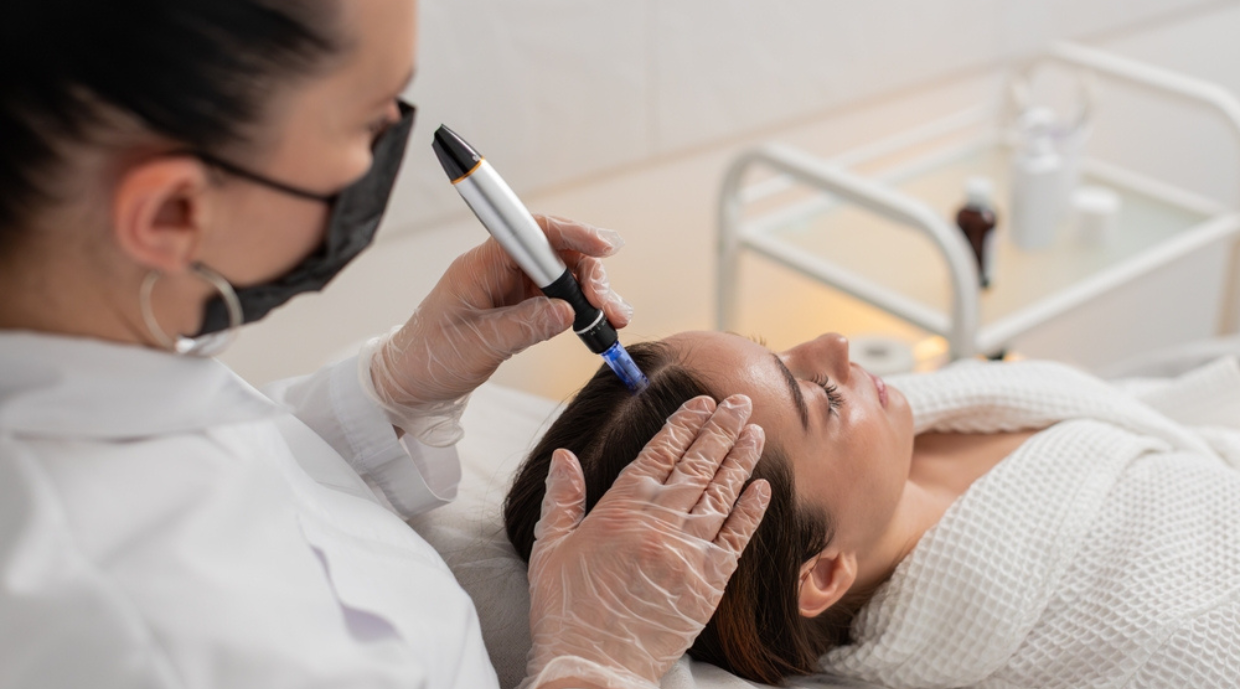
If you are considering PRP treatment in Bangalore for hair loss, one of the first questions you may have is how many sessions you will need. While it is natural to want a fixed number before starting, PRP treatment plans are not identical for every patient.
The number and spacing of sessions depend on the cause of hair loss, stage of thinning, follicle activity, scalp condition, previous treatments, and how the hair responds over time. A proper assessment is therefore more useful than choosing a treatment package based only on session count.
What Is PRP Hair Treatment?
PRP stands for platelet-rich plasma. The procedure begins by collecting a small amount of the patient’s own blood. This blood is processed so that a platelet-rich portion of the plasma can be separated and prepared for use on selected areas of the scalp.
Platelets contain growth factors involved in tissue repair and biological signalling. PRP has been studied mainly for androgenetic alopecia, commonly known as male or female pattern hair loss.
However, PRP is not suitable for every cause of hair loss. Temporary shedding after illness, nutritional deficiencies, hormonal changes, scalp disorders, medication-related shedding, and other conditions may require a different approach.
Understanding the causes of hair loss and available treatment options is therefore important before deciding how many PRP sessions may be appropriate.
How Many PRP Hair Treatment Sessions Are Usually Needed?
PRP is generally planned as a series of treatments rather than as a one-time procedure.
An initial course of around three sessions, often spaced approximately one month apart, is commonly used in clinical practice and research. However, this should not be treated as a fixed rule for every patient.
Some people may require a different number of sessions depending on:
- Type of hair loss
- Stage of thinning
- Remaining follicular activity
- Scalp condition
- Response to earlier sessions
- Other ongoing treatments
- Overall health
A consultation for PRP hair treatment should therefore focus on an individualized schedule rather than guaranteeing results after a predetermined number of visits.
Why Does the Number of PRP Sessions Vary?
Several factors influence how a treatment plan may be structured.
Stage of Hair Loss
Someone with early thinning may have a greater number of active but miniaturized follicles than someone with advanced, long-standing hair loss.
PRP works with existing follicles. It does not create completely new follicles in areas where permanent follicular loss has already occurred.
The stage of thinning therefore influences both treatment suitability and how many sessions may be considered.
Type of Hair Loss
Most PRP research focuses on androgenetic alopecia.
Hair shedding associated with nutritional problems, hormonal changes, recent illness, medications, significant stress, or inflammatory scalp conditions may need different management.
This is why diagnosis should come before deciding the treatment schedule.
Individual Response
Two patients undergoing a similar PRP schedule may respond differently.
One person may first notice reduced shedding, while another may take longer before changes in hair thickness or density become apparent.
Treatment should therefore be reviewed according to response rather than automatically continued for a fixed number of sessions.
Scalp Health
Active inflammation, infection, significant dandruff, or another scalp condition may influence treatment planning.
In some cases, the scalp concern may need to be managed before or alongside PRP.
How Far Apart Are PRP Hair Sessions?
PRP sessions are usually spaced rather than performed very close together.
During an initial treatment course, appointments may be separated by several weeks. This allows the scalp to recover and gives the hair follicles time to progress through their natural growth cycle.
Performing PRP more frequently does not automatically produce faster hair growth.
The exact interval should be decided according to the treatment protocol, diagnosis, and response.
Patients exploring broader hair loss treatment options should also understand that different procedures may follow different schedules. The number of PRP injections should not be viewed as the only factor determining treatment success.
When May You Start Seeing Results?
PRP should not be judged within a few days of treatment.
Hair grows gradually. Some patients may first notice a reduction in shedding before visible changes in thickness or density become easier to identify.
Results may depend on:
- Severity of thinning
- Follicle condition
- Hair-growth cycle
- Underlying diagnosis
- Scalp health
- Treatment consistency
- General health
- Individual response
Visible changes are generally assessed over several months rather than immediately after a session.
Standardized photographs taken under similar lighting and angles can provide a more useful comparison than checking the mirror every day.
Is One PRP Session Enough?
A single PRP session is generally too early to judge the overall treatment response.
Most treatment protocols for pattern hair loss use multiple sessions because hair follicles need time to progress through different stages of the growth cycle.
This does not mean that every patient automatically needs a large number of sessions.
The correct number should depend on the diagnosis and clinical response.
More injections do not necessarily mean faster or better hair growth. Completing an appropriate initial course and reviewing the response is more useful than automatically adding extra sessions.
Are Maintenance PRP Sessions Needed?
Some patients may be advised to undergo maintenance after completing the initial treatment course.
Pattern hair loss can continue to progress over time. Even if improvement is seen after an initial series, the underlying tendency toward thinning may remain.
Maintenance schedules can vary considerably.
One person may be advised to return periodically, while another may only need follow-up to monitor whether the hair remains stable.
Maintenance should therefore be based on:
- Treatment response
- Stability of hair loss
- Continued shedding
- Follicle condition
- Other treatments being used
- Progress during follow-up
It should not automatically be scheduled indefinitely for every patient.
What If PRP Does Not Work After Several Sessions?
More treatment is not always the right answer when results are limited.
If there is little meaningful improvement after an appropriate review period, the underlying diagnosis may need to be reconsidered.
Persistent hair loss may involve:
- Nutritional deficiencies
- Hormonal changes
- Medical conditions
- Medication effects
- Scalp disorders
- Advanced follicular loss
Another treatment strategy may therefore be more appropriate.
For selected patients, GFC and PRP treatment options may both form part of the wider discussion around non-surgical hair management.
The choice should be based on the condition being treated rather than simply switching procedures because results appear slower than expected.
How Is the Right Number of PRP Sessions Decided?
A hair and scalp assessment should come before deciding on the treatment schedule.
The clinician may review:
- When hair loss started
- Whether it is progressing
- Pattern of thinning
- Family history
- Recent illness or stress
- Medications
- Previous hair-loss treatments
- Scalp symptoms
- General health factors
The scalp may also be examined for hair density, follicular miniaturization, inflammation, scaling, and other signs that may influence the diagnosis.
After treatment begins, progress should be reviewed at suitable intervals.
The original plan may then be continued, modified, or stopped depending on how the hair responds.
The aim is not simply to complete a certain number of injections. The aim is to use PRP only when it fits the diagnosed condition and provides a meaningful response.
Does Having More Sessions Improve Results?
Not automatically.
Hair follicles follow biological growth cycles. Increasing the number or frequency of sessions does not force them to grow faster.
Additional sessions should only be considered when the treatment plan and follow-up assessment support them.
If progress is slower than expected, it may be more useful to review the diagnosis, scalp health, stage of follicular loss, and contributing medical factors.
Treatment should be adjusted according to response rather than continued simply because more sessions are available.
How Should PRP Progress Be Monitored?
Hair appearance can vary considerably from day to day.
Lighting, styling, hair length, oiliness, washing, and the way the hair is parted can all change how dense the scalp appears.
Progress may therefore be monitored using:
- Standardized photographs
- Changes in shedding
- Scalp examination
- Hair-density assessment
- Hair-shaft changes
- Review of thinning progression
Follow-up helps determine whether another session is appropriate or whether the overall strategy needs to change.
Conclusion
There is no single number of PRP sessions suitable for everyone experiencing hair loss.
An initial course of around three sessions is commonly used, but the actual number, spacing, and need for maintenance depend on the type and stage of hair loss, scalp condition, follicular activity, and individual treatment response. This individualized approach is also central to the original draft. Pasted markdown
If you are considering PRP treatment in Bangalore, begin with a professional hair and scalp assessment rather than choosing a fixed treatment package based only on session count.
A proper evaluation helps determine whether PRP is suitable, how the sessions should be planned, and when the treatment response should be reviewed.
Frequently Asked Questions
1. Are three PRP sessions enough for hair loss?
Three sessions are commonly used as an initial treatment course, but they are not automatically sufficient for every patient. The final number depends on the diagnosis and response.
2. How long should I wait between PRP hair sessions?
Initial sessions are often spaced several weeks apart. The exact interval depends on the treatment protocol, scalp condition, and individual plan.
3. Will more PRP sessions give faster hair growth?
Not necessarily. Hair follows a natural growth cycle, so increasing the number or frequency of sessions does not guarantee faster results.
4. When should PRP results be assessed?
Progress is generally assessed over several months rather than immediately after treatment. Changes in shedding may appear before visible differences in thickness or density.
5. Do I need PRP maintenance treatment forever?
Not necessarily. Some patients may benefit from periodic maintenance, while others may only need monitoring. The frequency should depend on follow-up assessment and whether hair loss remains active.


